


Thursday, October 29, 2026  ·  Manila
 Breaking News, Special Reports and In-Depth Stories in the Philippines
TSR
Nation

PHIVOLCS warns of 500ºC-volcanic deposits on the slopes of Mayon Volcano

PHIVOLCS warns of 500ºC-volcanic deposits on the slopes of Mayon Volcano
Share

The situation, in brief

The Philippine Institute of Volcanology and Seismology (PHIVOLCS) warned that the accumulated volcanic debris blocking the Mi-isi-Binaan Channel on Mayon Volcano could trigger “life-threatening secondary explosions” at any time due to temperatures reaching as high as 500ºC. In a report from the…

The Philippine Institute of Volcanology and Seismology (PHIVOLCS) warned that the accumulated volcanic debris blocking the Mi-isi-Binaan Channel on Mayon Volcano could trigger “life-threatening secondary explosions” at any time due to temperatures reaching as high as 500ºC.

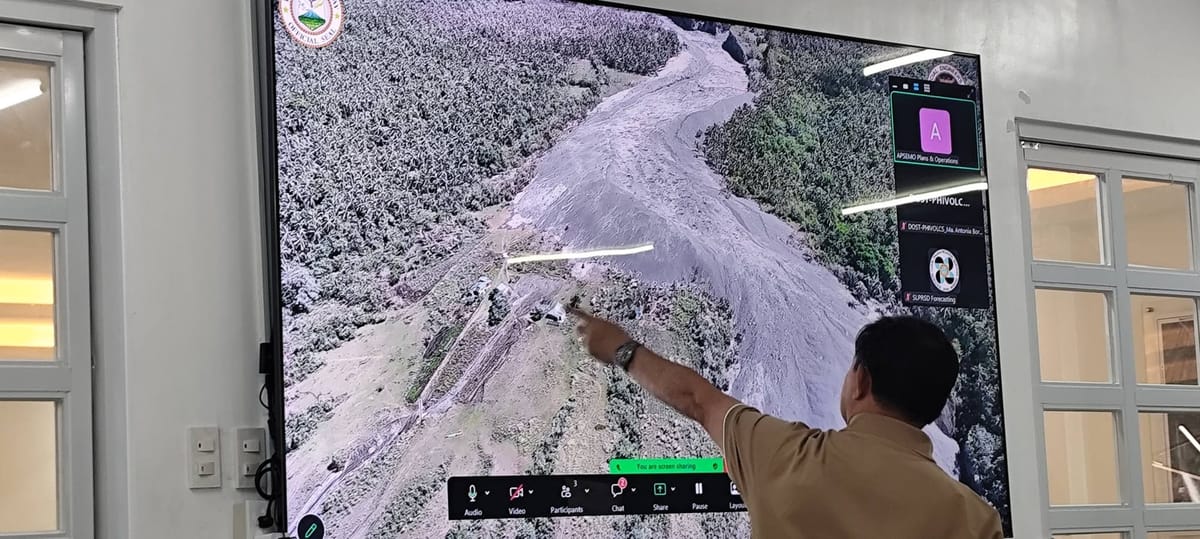
In a report from the state-run Philippine Information Agency in Albay, Doreen Abelinde, resident volcanologist at the PHIVOLCS Mayon Observatory, explained that the pyroclastic density current (PDC), or “uson,” emitted by the volcano on Saturday, May 2, traveled up to 5.4 kilometers from the crater down to the Mi-isi-Binaan River in Daraga.

“Napakainit ng newly erupted PDC deposits kaya’t ‘di pa ito maaaring galawin o alisin sa pamamagitan ng quarrying o desilting,” she said.

In the report, Abelinde further explained that the PDC deposits could divert river flow and trigger lahar during torrential rains, posing danger to residents in Daraga.

In a separate statement, PHIVOLCS said, “New PDC deposits in the Mi-isi-Binaan Channel are actively degassing, have very high-temperature interiors (may exceed 500ºC) and could undergo life-threatening secondary explosions where these are thick and volcanic gases tend to accumulate.”

“Secondary explosions have occurred in thick PDC deposits of the 2018 eruption, and more intensely, in the deposits of the 1991 Pinatubo eruption. Access to these deposits must thus be prohibited because of these reasons, on top of the fact that these are all within the PDZ,” it added.

PHIVOLCS advised barangay officials in communities near Mayon Volcano to immediately inform authorities if they observe unusual changes in water flow in their areas.

State volcanologists also warned that lahar could pass through newly formed channels after other areas became blocked by volcanic debris.

Abelinde reminded the public to avoid the six-kilometer permanent danger zone (PDZ) for their safety.

For now, PHIVOLCS said there are no indications that Mayon Volcano’s status will be raised to Alert Level 4 based on current volcanic data and monitoring parameters. — Photo from PIA Albay


More on Nation

See all
Marcos’ net satisfaction ratings drops to ‘poor’ in latest SWS survey
Nation

Marcos’ net satisfaction ratings drops to ‘poor’ in latest SWS survey

President Ferdinand Marcos Jr.’s net satisfaction rating fell to “poor” from “neutral” in the third-quarter survey of the Social Weather Stations (SWS). Marcos’ net satisfaction rating dropped to -11 in September 2026 from -7 in June, according to the survey. The SWS said 35% of adult Filipinos…

Magellan may have reached the Philippines because of El Niño — without knowing it: study
Nation

Magellan may have reached the Philippines because of El Niño — without knowing it: study

Portuguese explorer Ferdinand Magellan may have reached the Philippines in 1521 because of El Niño, without him or his fellow voyagers knowing it. A 2021 study by Dr. Scott Fitzpatrick of North Carolina State University and Dr. Richard Callaghan of the University of Calgary examined Magellan’s…

More than one teaspoon of salt increases risk of heart diseases, stroke — WHO
Nation

More than one teaspoon of salt increases risk of heart diseases, stroke — WHO

Cardiovascular diseases remain the world’s leading cause of death—not only in the Philippines—the World Health Organization (WHO) said. According to the WHO, cardiovascular diseases claim an estimated 17.9 million lives each year, with excessive salt intake identified as one of the key…

‘Very strong’ El Niño may emerge by October, PAGASA warns: ‘This should be taken seriously’
Nation

‘Very strong’ El Niño may emerge by October, PAGASA warns: ‘This should be taken seriously’

Reduced rainfall may be experienced in the coming months as the El Niño phenomenon continues to rapidly strengthen and may persist until the first half of 2027, according to the PAGASA. Ana Solis, chief of PAGASA’s Climate Impact Assessment and Prediction Section, said warming ocean temperatures…

Free newsletter

The Morning SitRep

The day’s most important stories in the Philippines and the world, in one five-minute read. Delivered at 6 AM, Monday to Saturday.

Breaking alerts Special reports first No spam
Check your inbox — we’ve sent a link to confirm your subscription.Something went wrong. Please try again in a moment. By subscribing you agree to TSR’s privacy policy.